

I-REC Service (International Renewable Energy Certificates)

What is I-REC
I-REC stands for International Renewable Energy Certificate. It is a type of Energy Attribute Certificate (EAC) that certifies electricity generation from renewable energy sources. The I-REC is verified by The Green Company Certificate (GCC) and is an internationally recognized standard.
The I-REC market emerged from the growing demand of businesses and organizations seeking to demonstrate environmental responsibility and transition toward the use of renewable energy. In many cases, organizations may be unable to further increase their share of renewable energy due to various limitations — such as budget constraints, space availability, or technical challenges. At the same time, some generators are able to generate more clean energy than they consume. This has led to the creation of a mechanism for trading I-RECs, allowing the exchange of renewable energy attributes between producers and consumers.
Total Capacity
Total Project
In other words, producers who generate more clean energy than they need may wish to transfer the rights to claim the excess clean energy to organizations that still seek to make such claims. This transfer is conducted through a trusted intermediary to ensure the rights are certified and recognized internationally. This process has led to the establishment of the I-REC standard, which is now verified and actively traded worldwide.
I-REC Services by Gunkul
As a leading renewable energy company in Southeast Asia, Gunkul focuses on supplying clean energy from solar and wind power both in Thailand and abroad. Currently, Gunkul is properly registered with I-REC and is able to generate up to 820,000 MWh per year (820,000 RECs) in Thailand and Vietnam.
In Thailand, Gunkul produces 580,000 MWh per year, comprising 190,000 MWh from solar and 390,000 MWh from wind. In Vietnam, production comes from solar energy totaling 240,000 MWh per year (data referenced from 2024).
Gunkul can issue I-REC certificates for companies seeking to reduce their greenhouse gas emissions. These certificates can be applied in various ways: Offset Scope 2 emissions in CFO and CFP reports. Demonstrate environmental responsibility and sustainability in the One Report.
For more information, you can click the ‘Contact Us’ button to get in touch with the Gunkul team.
Who is I-REC suitable for and what are its benefits?
Suitable for organizations seeking to reduce their greenhouse gas emissions in energy consumption reports (Scope 2)
I-REC allows organizations to increase the share of clean energy in their Scope 2 energy consumption reports and offset greenhouse gas emissions from fossil energy used in production or operations. This helps reduce the overall carbon footprint of the organization and its products. In some cases, organizations need to increase the proportion of clean energy used to ensure that their products or services have a lower carbon footprint, meeting the expectations of customers or business partners.

Suitable for organizations with environmental targets, both mandatory and voluntary
I-REC is an accessible option due to its relatively low cost and can help organizations demonstrate their commitment to environmental stewardship by supporting the use of renewable energy and enhancing their environmental image. This is increasingly valued by consumers, investors, and stakeholders. Many organizations set environmental targets to align with national goals or comply with industry regulations. One of the most efficient and cost-effective ways to achieve these targets is by purchasing I-RECs to offset the organization’s carbon footprint in various areas, helping meet their established environmental objectives.
Steps to Purchase I-REC
Estimate the amount of I-RECs
Estimate the amount of I-RECs needed to offset greenhouse gas emissions according to your set targets.
click here to see an exampleContact I-REC seller to request a quotation
Contact Gunkul (to request a quotation) and provide the necessary details.
(see the checklist here)Finalize the purchase agreement
Agree on a contract between the buyer and the seller or issue a purchase order (PO).
Await processing
Approximately 15–30 days for the seller to prepare the documents and submit the request for I-REC issues to the certifying body in each country.
I-REC Delivery
Upon receipt of the I-RECs, the seller will deliver them to the buyer as scheduled.
WHY GUNKUL?
- Lower cost than the market: As a direct producer, Gunkul does not charge any brokerage fees or sell through agents.
- I-REC delivery before payment: Clear contracts or purchase orders are issued to ensure accuracy and guarantee delivery on the agreed date.
- Leading renewable energy company in Southeast Asia: Gunkul focuses on supplying clean energy from solar and wind power both in Thailand and abroad.
- Properly registered with I-REC: The device names can be verified on IREC Evident to confirm registration. If a device ID is registered with I-REC, it means that the clean energy produced by that device is eligible for I-REC certification.
I-REC Certified Projects in Thailand
Gunkul is an expert in producing and distributing Renewable Energy Certificates (REC). We generate RECs from reliable clean energy sources, including solar and wind power, with a total installed capacity of 308 MW, equivalent to up to 590,000 MWh of REC per year. This includes 190,000 MWh per year from solar and 400,000 MWh per year from wind (data referenced from 2024).
Gunkul is properly registered and adheres to international certification standards, ensuring that each REC unit is transparent, verifiable, and delivers genuine environmental impact. Our clean energy power plants registered under the I-REC standard are located across Thailand.

Our Projects Cover

Total Project

Kanchanaburi

Lampang
Nakhon Ratchasima
Nakhon Nayok
Phetchabun
Phetchaburi
Phichit
Phrae
Prachuap Khiri Khan
Sa Kaeo
Samut Sakhon
I-REC Certified Projects in Vietnam
As a leading renewable energy company in the region, GUNKUL is committed to delivering high-quality, transparent, and sustainable clean energy solutions while supporting the environmental goals of clients at all levels.
Vietnam is another country where Gunkul has invested in clean energy, focusing on solar power projects under power purchase agreements with Vietnam Electricity (EVN), the national electricity utility. These projects have a total installed capacity of 160 MW, equivalent to up to 240,000 MWh of REC per year (data referenced from 2024).
Gunkul’s solar power plants registered under the I-REC standard in Vietnam.
Our Projects Cover
Total Project
Tay Ninh
Phong DienThua Thien Hue
Factors Affecting the Price of I-REC
- The price of I-RECs fluctuates according to market supply and demand.
- Redemption of certificates is more expensive than a simple transfer of rights.
- Purchasing through an agent is more costly than buying directly from a producer like Gunkul.
- Buying small quantities or needing I-RECs on short notice can increase the price.
- The price of I-RECs in the current year is typically higher than in previous years.
- The type of technology (e.g., solar or wind) can affect the price.
Price Trends I-REC
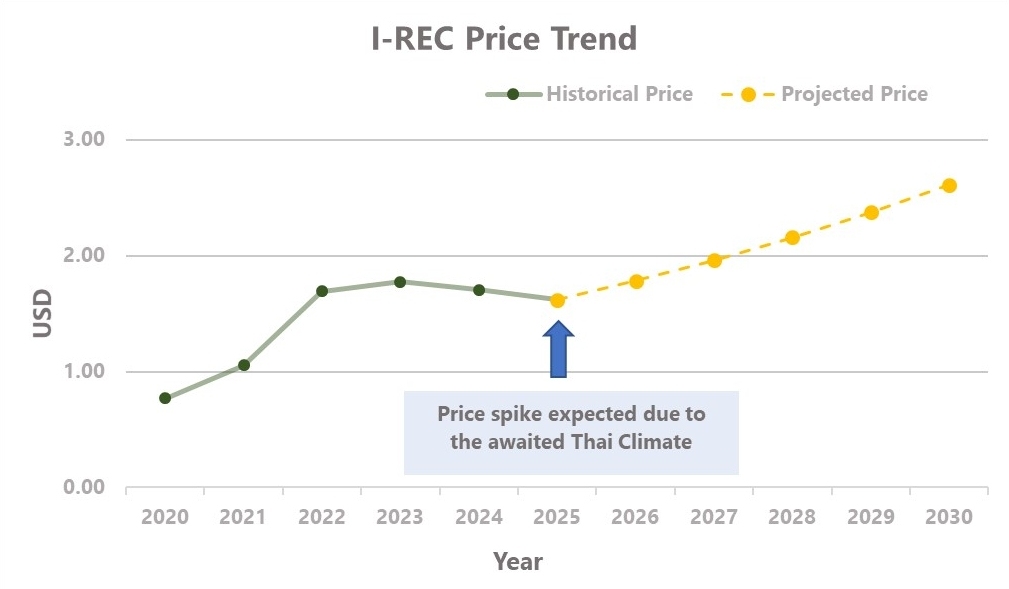
Currently, the price of I-RECs in Thailand tends to increase every year, especially in countries with high demand from the corporate sector, which drives prices upward. Compared to the global market, Thai prices are influenced by pressure from parent companies abroad to set targets for reducing greenhouse gas emissions, as well as by the upcoming Greenhouse Gas Act that the government is considering and preparing to enforce. This is expected to result in higher demand in the future.
Note:
- Prices are market-based and may vary depending on the agreement between the buyer and the seller.
- The estimated I-REC prices for 2025–2030 are based only on statistical data and received offers.
(Due to the enforcement of the Greenhouse Gas Act to promote emission reductions, I-RECs are expected to become increasingly popular, and therefore their prices are likely to rise.)
FAQs
The purpose of I-REC is to support renewable energy, with 1 I-REC = 1 MWh. In contrast, a carbon credit is used to offset greenhouse gas emissions, with 1 carbon credit offsetting 1 ton of CO₂ equivalent.
- Set a target for the percentage of electricity consumption you want to offset with renewable energy.
- Calculate the total electricity usage of each plant and the company for a month, quarter, or year.
- Convert the electricity usage to the number of I-RECs needed, using the unit conversion of 1 MWh = 1 I-REC.
For example, if the target is to achieve RE30% and the current electricity consumption from conventional sources is 10,000 MWh, the company would need to purchase 3,000 I-RECs to offset 30% of the greenhouse gas emissions, or 3,000 MWh of electricity used.
You can check the eligibility requirements for registration, which include: the electricity must be generated from renewable energy, the system must be able to feed power into the grid, it must have the necessary legal permits, ownership must be verifiable, and it must be certified by an authorized verifier, such as the Electricity Generating Authority of Thailand (EGAT).
However, electricity produced solely for self-consumption cannot be registered for I-REC, as it has already reduced greenhouse gas emissions by using clean energy internally.
- I-REC transfer – After a successful purchase, ownership of the I-REC credit is transferred to the new owner, i.e., the I-REC buyer, at the desired time and for the specified technology, at an agreed price.
- REC redemption – This is the redemption of I-RECs for the “beneficiary” through an intermediary. Users can claim the use of renewable energy without necessarily consuming the actual renewable electricity.
Yes, I-RECs are designed according to internationally recognized standards and can be traded in many countries across different regions, such as Thailand, Vietnam, China, Mexico, Brazil, South Africa, and more.
The Carbon Border Adjustment Mechanism (CBAM) mainly targets the reduction of Scope 1 greenhouse gas emissions. Therefore, I-REC is not directly related, as it focuses on increasing the share of renewable energy use and offsetting emissions in Scope 2. Currently, CBAM does not recognize I-REC as a primary measure for reducing the carbon footprint of products entering Europe.
The Climate Change Act promotes the reduction of greenhouse gas emissions to meet the targets Thailand agreed to under the Paris Agreement. This increases the demand for clean energy to comply with the new law. As a result, the demand for I-RECs is also rising, as they help offset greenhouse gas emissions in Scope 2.
I-RECs can be applied in various ways for CFO (Carbon Footprint of Organization), CFP (Carbon Footprint of Product), and One Report. They can be used to offset Scope 2 greenhouse gas emissions in CFO and CFP reports and to demonstrate environmental responsibility and sustainability in One Report.
- Calculate the total electricity consumption in Scope 2 for each plant and the company over a month, quarter, or year.
- Set a target for the percentage of electricity you want to offset with renewable energy.
- Convert the electricity usage to the number of I-RECs needed, using the unit conversion of 1 MWh = 1 I-REC.
Example: Factory A aims to achieve RE30 (30% clean energy and 70% fossil-based energy). Suppose Factory A consumes 10,000 MWh of fossil-based electricity in Scope 2, generating greenhouse gas emissions. Factory A installs solar panels to reduce emissions, but can only offset 1,000 MWh directly.
Therefore, Factory A needs to purchase an additional 2,000 I-RECs to reach the RE30 target and claim the use of clean energy. This offsets 30% of the greenhouse gas emissions, or 3,000 MWh out of the 10,000 MWh emitted.
- Type of renewable energy technology: Solar or Wind
- Consumption year
- Country: Thailand / Vietnam
- Volume of I-RECs
- Type of transaction: Transfer or Redemption (If Transfer, the buyer will receive I-REC credits, If Redemption, the buyer will receive I-REC certificates)
- Preference for contracting: whether to execute a contract between buyer and seller or issue a purchase order independently